Z3 Data Alternative: Reported Tonnage, Measured Tonnage, and What Your Reports Have to Survive
Of all the companies Dyrt gets compared to, Z3 Data is the one whose diagnosis of the problem is closest to ours. Both start from the same observation: waste data arrives in whatever format each hauler feels like sending, nobody can roll it up, and the spreadsheet somebody maintains by hand is the real system of record. Both answer it by building a normalization layer.
The divergence is about where the numbers originate and how far the platform goes once it has them. If you are evaluating a Z3 Data alternative, that is the axis to evaluate on, and this post lays it out — including the cases where Z3 is the more sensible purchase.
What does Z3 Data actually do?
Z3 describes its offering as "a Software-Enabled Service that supports waste diversion and simplifies sustainability reporting." Its published capabilities are automated data collection from haulers and waste providers, standardization of raw data into structured formats, real-time reporting and analytics for diversion tracking, and compliance support for regimes including TRUE Certification, B-Corp, and CDP.
Invoice capture runs through a component Z3 calls Zenbi: in Z3's words, "simply email or upload invoices and remittances, and Zenbi captures the information directly into the Z3 system, eliminating manual entry." Its FAQ states that the platform ingests, standardizes, and validates waste-related data across every property, and that it detects billing issues including weight anomalies, duplicate billing, incorrect frequencies, misaligned container sizes, unusual contamination fees, and pricing inconsistencies. It provides historical service-level and weight data to support procurement teams at contract renewal.
On emissions, Z3 says it follows the GHG Protocol methodology and uses the most recent US EPA GHG emissions inventories for Scope 3 Category 5. It supports API integrations and structured CSV exports into ESG platforms, BI tools, and accounting systems. Its FAQ is admirably direct about limits: Z3 provides no physical waste equipment or hauling services, and its service "does not meet EPA Uniform Hazardous Waste Manifest compliance requirements," though it can collect and summarize manifest data. Most clients onboard in four to eight weeks.
That is a clean, well-scoped product. It is a data layer that makes hauler-reported information usable and reportable.
Where does Dyrt draw the line differently?
Dyrt does the same normalization work — ingesting through vendor APIs, EDI, email parsers, and PDF OCR, then reconciling billing periods across haulers, converting units, deduplicating, and mapping vendor facility IDs onto your site hierarchy in Spend Intelligence. Two things extend past that boundary.
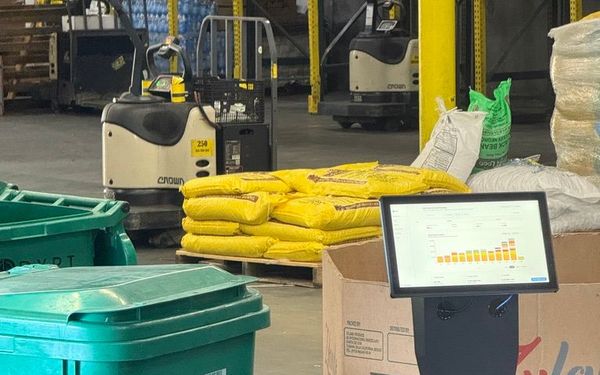
The first is the origin of the tonnage. A normalization layer fed by hauler documents inherits whatever the hauler reported. If the hauler's scale ticket says 3.4 tons, the platform says 3.4 tons, and every diversion rate and emissions figure downstream rests on that number. DWIT — the Dyrt Waste Intelligence and Integrated Kiosk System — creates an independent record: an industrial scale rated 5,000+ lbs, weatherproof, at the point where waste leaves the building, with a three-tap operator workflow of load, select, confirm, against a stream taxonomy configured for that site. Optional load photo and notes. Offline-capable, queuing records and syncing on reconnect. Managed by Dyrt over a private VPN with rolling updates, with a spare-parts kit in every install.
The second is what happens after a finding. Detecting a duplicate charge and resolving one are different activities. Dyrt types every finding as dispute, renegotiate, right-size, or audit, and in the Portfolio Intelligence tier Dyrt executes rather than recommends: national vendor management across hauler and utility contracts, continuous invoice audit and dispute resolution, right-sizing and switch execution, ground-truth verification from loading docks and food-and-beverage teams, monthly reporting, and quarterly business reviews. That tier is built for hospitality, venue, and retail portfolios of 50-plus locations.
Positioning comparison. The Z3 Data column reflects what Z3 publishes on z3data.com; the Dyrt column reflects shipped capability.
| Dimension | Z3 Data | Dyrt |
|---|---|---|
| Model | Software-Enabled Service; data normalization and reporting layer | Software platform with hardware, plus an optional fully managed tier |
| Invoice ingest | Zenbi — email or upload invoices and remittances | Vendor APIs, EDI, email parsers, PDF OCR, monthly |
| Tonnage source | Hauler and vendor reported data | Hauler documents plus independently weighed loads where DWIT is installed |
| Billing anomalies | Detects weight anomalies, duplicate billing, wrong frequencies, container mismatches, contamination and pricing inconsistencies | Same detection, typed into dispute, renegotiate, right-size, audit — with dispute execution in the Optimize tier |
| Frameworks named | TRUE Certification, B-Corp, CDP; GHG Protocol with US EPA inventories | LEED, GRI, CDP, TCFD, SBTi, SB 253, SEC; EPA WARM |
| Hardware | None — explicitly no physical equipment or hauling | DWIT kiosk, one-time hardware plus monthly subscription per location |
| Exports | API integrations and structured CSV | CSV, JSON, API |
Why does it matter whether tonnage is reported or measured?
For internal dashboards, often it does not. A hauler-reported tonnage series is usually directionally right, and if you are trying to find out which of your two hundred sites is an outlier, directional is enough.
It starts to matter in three specific places. The first is assurance. When an external reviewer asks how you know a diversion figure, "our hauler told us" is a chain of custody with one link and no independent verification in it. Dyrt builds Scope 3 Category 5 from measured diversion data rather than spend estimates, and maintains an auditable chain of custody from bin to facility, precisely because that question gets asked.
The second is disputes. You cannot contest a hauler's weight using the hauler's weight. Detecting a "weight anomaly" in reported data tells you a number looks strange; a weighed load record on your dock tells you what the number should have been.
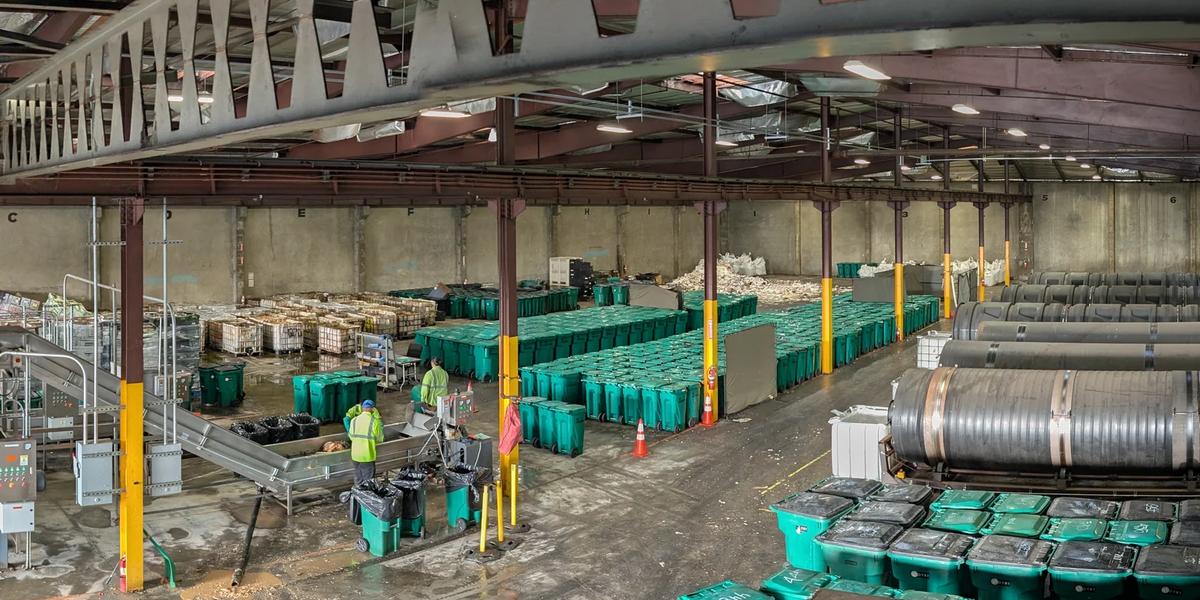
The third is composition. Reported data has a stream label on it, not a material breakdown. Dyrt runs Labs in Vernon, California, at roughly 1,000,000 lb per month of throughput, where Dyrty Vision applies computer vision over organics sort lines, composition models are in pilot with two hospitality groups, and lifecycle attribution work connects material back to its origin. That research is only possible if you control the measurement point.
Both platforms detect. What differs is what happens next.
Duplicate or unsupported charge
Detected from documents by either platform. Resolving it means filing with the hauler and following it to credit.
Recommendation: Dyrt types this as a dispute and, in the Optimize tier, files and pursues it on your behalf.
Pricing inconsistency across sites
Visible once units and site identifiers are normalized. Acting on it means opening a contract conversation.
Recommendation: Take the benchmark into renewal; Optimize executes the switch if the incumbent will not move.
Container size or frequency mismatch
Inferable from reported service data; provable from weighed hauls, where consistently light loads are unambiguous.
Recommendation: Downsize or reduce frequency, then verify against measured weight.
Unusual contamination fee
Flagged as anomalous either way. Contesting it requires an independent record of what was actually in the load.
Recommendation: A weighed record with an optional load photo is what turns this from a query into a claim.
The same normalized dataset is what feeds Impact Engine, where Scope 3 Category 5 is built from measured diversion rather than spend estimates, EPA WARM factors are applied, and the chain of custody runs from bin to receiving facility.
You need portfolio visibility, trend detection, and a report that satisfies an internal or certification audience that accepts vendor-reported figures.
A reviewer, regulator, or hauler is going to challenge the number, or when your diversion rate is a public commitment rather than an internal metric.
You have a procurement or facilities team with the time and mandate to chase findings through to credit and contract change.
Findings pile up in a queue nobody works. A flagged anomaly that nobody files is not a recovery — it is a task, and waste tasks lose to every other task.
What should you ask both vendors?
- Trace one tonnage number end to end. Which document produced it, who created that document, and is there any independent check on it?
- How do billing periods get reconciled when haulers close their months on different days? Ask to see two sites with mismatched cycles rolled up correctly.
- How does the vendor facility ID get mapped to our site hierarchy, and what happens when a site is renamed, acquired, or re-regioned?
- When an anomaly is detected, what does the platform hand us, and who takes it to the hauler?
- Which reporting frameworks are supported natively as exports rather than as a spreadsheet we reformat?
- What is onboarding, in weeks, for a portfolio our size — and what is the gating dependency, hauler cooperation or our own data?
Onboarding timelines tell you where the friction lives
Any waste data platform’s onboarding time is dominated by getting historical documents out of haulers and reconciling site identifiers, not by software configuration. Ask both vendors what they do when a hauler simply will not cooperate. The answer reveals how complete your dataset will actually be in month three.
When is Z3 Data the better fit?
Several situations favor Z3, and a reader in one of them should buy Z3 without agonizing over it.
When you need a normalization layer under an ESG platform you already own. Z3 positions itself explicitly as a data layer with API and CSV exports into existing sustainability and BI systems. If your reporting stack is settled and the only gap is clean waste data flowing into it, that is exactly the product being described.
When TRUE Certification is the driving requirement. Z3 names TRUE, B-Corp, and CDP directly, and certification-driven programs have specific documentation needs. If TRUE is the deadline on your calendar, buy the vendor that talks about TRUE.
When hardware is off the table. Z3 is unambiguous that it supplies no physical equipment, and for some portfolios that is the feature. Leased sites, shared compactors, high staff turnover, or a flat internal refusal to add a step at the dock all make a hardware-dependent model the wrong purchase.
When you want to move quickly and narrowly. Z3 publishes onboarding in four to eight weeks and a scope that stops at data. A tightly bounded project that finishes is worth more than a broader one that stalls, and Dyrt would rather you succeed with Z3 than stall with us.
When you are outside our ICP. Dyrt is built for multi-site hospitality, venues, retail and grocery chains, and distribution. Z3 markets to manufacturers among others. If your waste problem is process material inside a plant rather than back-of-house in a portfolio of properties, our design assumptions are not yours.
How do you decide?
Ask what the dataset has to survive. If it has to survive an internal review and feed a report, a reported-data normalization layer is a proportionate answer and a faster one. If it has to survive an assurance reviewer, a hauler's billing department, or a public commitment, the measurement point has to be yours.
Dyrt's tiers exist to make that a staged commitment. Track measures. Capture adds full visibility into every dollar of spend. Optimize hands the function over. Pricing is per location, kiosks are one-time hardware plus a monthly subscription per location, and there are no per-seat or per-feature gates — so the decision is which capability you need, not which package unlocks it.
For the direct comparison, see Dyrt vs Z3 Data: waste tracking and reporting compared.
Dyrt Team
Dyrt Editorial
The Dyrt team builds waste intelligence software for sustainability managers, CFOs, and facility operators. We help organizations reduce waste costs, hit diversion targets, and simplify Scope 3 reporting.
Ready to Transform Your Waste Operations?
Dyrt helps sustainability teams, facility operators, and CFOs cut waste costs, hit diversion targets, and simplify Scope 3 reporting — all in one platform.
Request a Demo