How to Evaluate Waste Management Software: A Buyer’s Framework
Waste management software is an unusually difficult category to evaluate, because most of the products in it demo well and differ underneath in ways a demo will not reveal. Every vendor will show you a dashboard with spend by site, a diversion rate, and a carbon number. The dashboards look similar. What differs is where each number came from, how much of it is measured versus inferred, who owns it, and who is expected to act on it — and none of that is visible from the screen.
This post is a framework for the questions that actually separate platforms. It is written by a vendor in the category, which you should factor in; we have tried to make it useful anyway by stating the questions in a form that a competitor could answer well, and by being explicit about the situations where a different kind of vendor — or no vendor — is the right answer. Those situations exist and pretending otherwise wastes everyone’s time in a sales cycle.
What should I actually be evaluating in waste management software?
Eight dimensions cover nearly everything that matters. They are not equally weighted for every buyer, and part of the exercise is deciding which three you care most about before you sit through a demo — otherwise you will be led through the vendor’s preferred three.
Eight evaluation dimensions
| Dimension | The question that separates vendors | Weak answer looks like |
|---|---|---|
| Measurement source | For each number on this screen, is it weighed, billed, or estimated? | “Our data comes from your haulers” with no distinction drawn |
| Data ownership and export | Can I export the full record set, including raw source documents, on demand? | Report-level PDF export only, or export as a paid add-on |
| Invoice and contract coverage | What percentage of my vendors can you ingest, and what happens to the rest? | A coverage claim with no mention of the manual fallback |
| Emissions methodology | Which calculation method, which factor set, and which version? | “We use EPA factors” without naming the method or dataset |
| Service model | Who contacts the hauler when a finding needs executing? | Findings are delivered; execution is “your team, with our support” |
| Implementation burden | What does each site have to do, in hours, in the first 90 days? | An answer about the vendor’s effort rather than the site’s |
| Integration surface | How does this reach my ERP, my sustainability system, and my BI tool? | CSV download described as an integration |
| Pricing structure | What causes the price to increase over three years? | Per-seat or per-feature pricing on a platform meant to be used widely |
Where does the vendor’s data actually come from?
This is the first question and it subsumes several others. Ask the vendor to walk through one specific number on the dashboard — say, last month’s landfill tonnage for one site — and trace it backward to its origin. There are only three possible origins and they are not interchangeable.
A scale produced a number. Independent of the hauler and of billing. Most defensible, most expensive to obtain, and requires hardware somewhere in the chain.
Derived from what the hauler charged. Cheap, complete, and structurally biased — it records the service transaction, not the material. A container pulled half full bills as a full haul.
Container size times an assumed fill percentage times a density factor. Fine for triage, and the source of most of the error in portfolio waste data. Ask what density factors are used and where they come from.
The point is not that estimated data is illegitimate. Every large portfolio has some, and a platform that refuses to estimate anything will simply have gaps instead. The point is that a platform should tell you which is which, per number, without being asked. If it cannot, then any downstream figure — cost per ton, diversion rate, Scope 3 Category 5 — inherits an unknown amount of assumption and you have no way to size it.
One question worth asking verbatim
“Show me a number on this dashboard that is estimated rather than measured, and show me where the interface tells me that.” A platform designed by people who take data provenance seriously will have an answer ready. A platform that markets a dashboard will not.
Who owns the data, and can I get it out?
Waste platforms accumulate something genuinely valuable over a few years: a normalized, multi-year, multi-site record of what your operation generates and what it cost. Whether that asset belongs to you in a practical sense — not just contractually — determines your position at every renewal.
Three specifics to press on. First, export scope: can you pull the full record set at the row level, including the raw source documents the platform parsed, or only formatted reports? Formatted reports are not your data; they are the vendor’s interpretation of it. Second, export mechanism: is there a documented API, or is export a support ticket someone fulfills manually within a business week? Third, exit: what happens to the historical record if you leave, and is that written into the agreement rather than described verbally.
A useful test is to ask for a sample export during evaluation, on real data if a pilot allows it. Vendors whose export is genuinely first-class will hand it over; vendors for whom export is a retention lever will find reasons to defer.
What share of my invoices and contracts can it actually read?
Ingestion coverage is where stated capability and delivered capability diverge most, because the long tail of vendors is genuinely hard. A national hauler with an EDI feed is straightforward. The regional recycler that emails a scanned PDF with handwritten annotations, the grease collector that invoices quarterly with no site identifier, and the municipal service billed on a utility statement alongside water are not.
Ask three things. What ingestion channels exist — API, EDI, email parsing, PDF OCR? What happens to a document that fails to parse: does it silently drop, appear in an exception queue, or get handled by a human at the vendor? And what fraction of your specific vendor list, which you should provide, is already supported today rather than supportable in principle?
The normalization work behind ingestion matters as much as the parsing. Reconciling billing periods onto a common calendar, converting units, detecting duplicate invoices, and mapping vendor account numbers to your own site hierarchy is the unglamorous work that determines whether the portfolio is comparable at all. Dyrt does this in Spend Intelligence and writes about the mechanics in a separate post; the reason to raise it here is that it is easy to under-scope in an evaluation because no demo shows it.
How is the emissions number calculated?
This is the dimension where vendors most often present incomparable numbers as equivalent, and it is worth understanding well enough to ask a precise question.
The GHG Protocol Corporate Value Chain (Scope 3) Standard sets out, for Category 5 — waste generated in operations — a set of calculation methods that differ in how much they rely on assumption: a supplier-specific method using data from the waste treatment company, a waste-type-specific method using tonnage by waste type and treatment pathway, and an average-data method that leans on generic factors where activity data is missing. The methods are described in the standard itself. Two vendors can both claim GHG Protocol alignment while sitting at opposite ends of that range.
So ask which method, and then ask which factor set and which version. In the United States the common choices are EPA’s WARM, which compares management pathways on a material-specific life-cycle basis, and the EPA GHG Emission Factors Hub. Both are updated periodically, which means the version used is part of the answer: a restated prior year is a normal consequence of a factor update, and a vendor who cannot tell you which version produced last year’s figure cannot support a restatement.
The practical consequence of methodology choice is auditability. A figure built from weighed tonnage by material and destination can be traced to a chain of custody; a figure built from generic averages applied to spend cannot, and will not survive a serious assurance process. Dyrt’s Impact Engine takes the weighed-tonnage-plus-WARM route, described in the post on measured Category 5. That is a legitimate choice and not the only one — an average-data approach is explicitly permitted, cheaper, and adequate for some reporting obligations. What is not legitimate is presenting one as if it were the other.
Who does the work — my team or the vendor?
Analytics-only platforms share a characteristic failure mode that has nothing to do with the quality of their analysis. They produce an accurate, well-formatted list of opportunities, deliver it to a facilities organization that is already fully committed, and the list does not get worked. Twelve months later the identified savings are still identified.
Executing a single right-size means contacting the hauler, confirming the service change, verifying it appears on the next invoice, and catching it when it silently does not. Each instance is small; across a portfolio, in aggregate, it is a job. So the question to ask is not whether the platform surfaces findings — they all do — but who performs those steps, and what the vendor’s answer is when a change is confirmed by the hauler and then never appears on a bill.
Three service models exist and each is appropriate for someone: software-only, where your team executes; software plus advisory, where the vendor recommends and coaches; and fully managed, where the vendor holds the vendor relationships and executes on your approval. Dyrt’s tiers — Track, Capture, and Optimize — map to roughly that progression. The mistake buyers make is choosing a software-only product while implicitly assuming someone will have capacity to work the queue.
What does implementation actually require from my team?
Ask for the implementation burden in site hours, not vendor hours, and ask it separately for three phases.
Assembling the site list, vendor list, contracts, and a document flow. Mostly central and mostly forwarding. Expect surprises: active service at closed sites is common.
The step that genuinely needs site knowledge — which streams exist here, what they are called, where each goes. Skimping produces compliant-looking data that misclassifies loads for years.
The recurring ask. If the answer involves a site coordinator compiling anything monthly, assume decay — first at the busiest sites, which are the ones you most need data from.
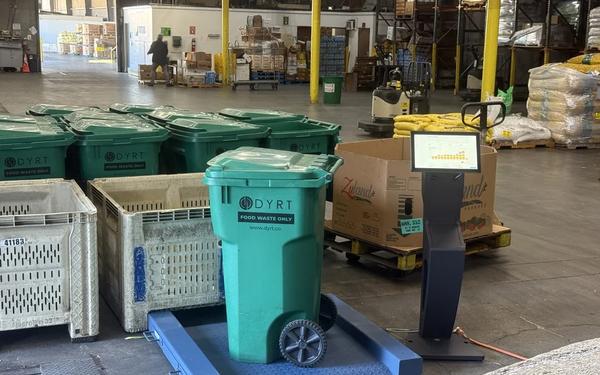
If hardware is part of the proposal, the implementation questions change. Where does it physically go, what does the site provide, does it survive a receiving area with forklifts and moisture, and what happens during a network outage? A capture device that stops recording when connectivity drops will have its worst gaps at the sites with the worst infrastructure, which introduces a bias correlated with site type. Dyrt’s DWIT kiosk queues locally and reconciles on reconnect for that reason; the general point is to ask any hardware vendor what their offline behavior is, and to be skeptical of an answer that assumes reliable back-of-house WiFi.
When is a different kind of vendor the right answer?
Being honest about this is partly self-interested — a bad-fit customer is an expensive customer — but mostly it is that the alternatives are genuinely better in specific, identifiable situations.
Where another category of vendor fits better
| Your situation | Better answer | Why |
|---|---|---|
| Fewer than roughly five locations | A spreadsheet and a competitive bid every two years | A per-location platform subscription will not pay back against a problem one person can hold in their head. Rebid the contracts and re-check fill levels annually. |
| You want one bill and no involvement at all | A fully managed waste broker | Brokers consolidate billing and own the hauler relationships. If you do not need site-level data, an audit trail, or an emissions figure, a broker is simpler and often cheaper. The trade is visibility and negotiating position. |
| Your mandate is enterprise-wide ESG reporting | A broad ESG platform or consultancy | Waste is one Scope 3 category among fifteen. If you need materiality assessment, assurance readiness, and Scopes 1 through 3 in one system, start there and feed waste data into it. |
| Regulated hazardous, medical, or e-waste compliance | A specialist compliance and manifest system | Manifest tracking and cradle-to-grave regulatory obligations are a distinct software category with distinct audit requirements. General waste platforms are not built for it. |
| You operate the trucks | Hauler-side routing and fleet software | Generator-side platforms are built for the customer of waste service. Route optimization, dispatch, and fleet telematics are a different product. |
| Shared containers you do not control | Landlord negotiation before software | In multi-tenant retail and mixed-use buildings, the volume you can measure is not the volume you control. Fix the container arrangement first; measuring a shared container produces a number you cannot act on. |
There is also a compliance case that cuts the other way and is worth naming. Where a jurisdiction imposes specific operational obligations — California’s SB 1383 framework, for instance, requires commercial businesses to provide organics and recyclables containers alongside disposal containers and to monitor for contamination under 14 CCR 18984.9 — the requirement is operational rather than analytical. Software helps you evidence compliance; it does not create it. A platform that markets itself primarily as a compliance solution for a mandate that is fundamentally about containers and staff behavior is overselling.
What questions should I ask in the demo?
A short list that is hard to answer well without a real product behind it. Each one is answerable by a good vendor of any kind, including ones that are not us.
- Pick a number on this dashboard. Trace it back to its source document or measurement for me.
- Show me where the interface distinguishes a measured value from an estimated one.
- Here is my vendor list. Which of these can you ingest today, and what is the fallback for the rest?
- Which GHG Protocol Category 5 method do you use, which factor set, and which version?
- When a right-size is approved, who calls the hauler, and who checks the next two invoices?
- What does each site have to do in hours during the first ninety days, and every month after?
- Export the full record set for a pilot site at row level, including source documents.
- What causes this price to go up over three years?
The two answers that predict everything else
How a vendor answers the provenance question and the execution question tells you most of what you need. A platform that knows exactly which of its numbers are measured, and that has a defined owner for the follow-through on every finding, is a platform built by people who have run the operation. The rest is feature comparison.
Waste is a small line on most budgets and a disproportionately messy one, which is why it survives so long unexamined. Any of the vendor categories above will beat leaving it unexamined. The framework above is meant to get you to the right one rather than to us — and if the honest read of your situation is a broker, an ESG platform, or a spreadsheet, that is a legitimate conclusion from a good evaluation.
Dyrt Team
Dyrt Editorial
The Dyrt team builds waste intelligence software for sustainability managers, CFOs, and facility operators. We help organizations reduce waste costs, hit diversion targets, and simplify Scope 3 reporting.
Ready to Transform Your Waste Operations?
Dyrt helps sustainability teams, facility operators, and CFOs cut waste costs, hit diversion targets, and simplify Scope 3 reporting — all in one platform.
Request a Demo