Waste Harmonics Keter Alternative: Outsource the Waste Function or Instrument It?
Waste Harmonics Keter puts its proposition in a single sentence on its own homepage: "We are here to get you out of the waste business." That is an unusually clear statement of intent, and it is worth taking at face value, because it identifies exactly the fork in the road that anyone searching for a Waste Harmonics Keter alternative is standing at.
You can outsource the waste function, or you can instrument it. Both are legitimate. They produce different organizations two years later, and the choice should be made deliberately rather than by whichever vendor called first.
What does Waste Harmonics Keter actually do?
Waste Harmonics Keter describes itself as "leading managed waste services — combining industry-leading service with data-driven technology to help you optimize operations." It is explicitly a managed-service model: the company takes over waste operations on the client's behalf.
The services it lists are full-stream waste and recycling solutions, tech-enabled right-sizing and optimization, full visibility into waste streams, hauls, and invoices, transparent reporting, dedicated service teams, and on-demand support with emergency response. It names its target industries as logistics and distribution centers, retail chains, convenience stores, restaurant brands, and hospitality groups, and emphasizes nationwide scale with local expertise, particularly for operations where downtime is expensive.
Note the industry list, because it overlaps heavily with Dyrt's. Multi-site hospitality, venues, retail and grocery chains, and distribution are the portfolios both companies are built for. That overlap is why the comparison comes up so often, and why the difference is about model rather than about market.
What is Dyrt proposing instead?
Dyrt is a software platform your team runs, with instrumentation at the point where waste leaves the building. Three components:
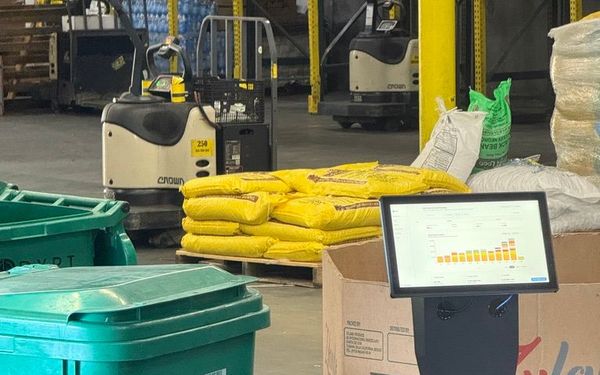
- DWIT — the Dyrt Waste Intelligence and Integrated Kiosk System. An industrial scale rated 5,000+ lbs, weatherproof, with a three-tap operator workflow: load, select, confirm. Waste-stream taxonomy configurable per site, optional load photo and notes, real-time portal sync, offline-capable so it queues and syncs on reconnect. Dyrt manages the fleet over a private VPN with rolling updates, and every install includes a spare-parts kit. See the hardware page for the full specification.
- Spend Intelligence — reads every line of hauler invoices and contracts, ingested via vendor APIs, EDI, email parsers, and PDF OCR, then normalized: billing periods reconciled across haulers, units converted, duplicates removed, vendor facility IDs mapped to your site hierarchy. Findings are typed as dispute, renegotiate, right-size, or audit. Detailed on the enterprise page.
- Impact Engine — Scope 1, 2, and 3 from bills, receipts, spreadsheets, and facility records, with Scope 3 Category 5 measured from real diversion data rather than spend estimates, EPA WARM factors, an auditable chain of custody from bin to facility, and exports for LEED, GRI, CDP, TCFD, SBTi, SB 253, and SEC. Detailed on the emissions page.
Dyrt also offers a managed tier. Portfolio Intelligence covers national vendor management across hauler and utility contracts, continuous invoice audit and dispute resolution, right-sizing and switch execution, ground-truth verification from loading docks and food-and-beverage teams, monthly reporting, and quarterly business reviews, for hospitality, venue, and retail portfolios of 50-plus locations. So the choice is not simply managed versus unmanaged. It is whether the managed relationship is built on top of a dataset you own.
The question underneath the model question
When a managed provider optimizes your waste, the operating knowledge accumulates in their organization. When a platform instruments your waste, it accumulates in yours. Neither is inherently right — but only one of them is still yours after a vendor change, and that is the thing to decide with your eyes open rather than discover at renewal.
Positioning comparison. The Waste Harmonics Keter column reflects what the company publishes on wasteharmonics.com; the Dyrt column reflects shipped capability.
| Dimension | Waste Harmonics Keter | Dyrt |
|---|---|---|
| Core model | Managed waste services — the provider runs the function for you | Software platform your team runs; Optimize tier is managed on top of it |
| Stated goal | To get you out of the waste business | To make waste a measured line item your own team can act on |
| Service execution | Dedicated service teams, on-demand support, emergency response | Your operators day to day; Dyrt executes vendor switches in the Optimize tier |
| Site instrumentation | Tech-enabled right-sizing and optimization; visibility into streams, hauls and invoices | DWIT weighing kiosk at the point of disposal — an independent weight record you own |
| Emissions and disclosure | Transparent reporting | Scope 1, 2, 3 with Category 5 from measured diversion; seven framework exports; CSV, JSON, API |
| Industries named | Logistics and distribution, retail chains, convenience stores, restaurant brands, hospitality | Multi-site hospitality, venues, retail and grocery, distribution |
What do you actually give up by outsourcing the function?
Three things, and it is worth being specific rather than ominous about them.
The first is the primary record. In a managed model, the record of what happened at your dock is created by the provider or by the hauler. That is usually fine and occasionally decisive — the day you want to contest a charge, or the day an assurance reviewer asks how you know your diversion rate, the answer traces back to a document you did not create.
The second is composition signal. Waste is the exhaust of purchasing. If a restaurant brand can see that a specific site discards a consistent weight of a specific material every week, that is a procurement finding, not a waste finding — and it only appears if somebody is measuring at the source with a per-site stream taxonomy. This is the direction Dyrt Labs is pushing: a facility in Vernon, California, processing roughly 1,000,000 lb per month, where Dyrty Vision applies computer vision over organics sort lines, composition models are in pilot with two hospitality groups, and lifecycle attribution ties material back to origin.
The third is negotiating position at renewal. Managed providers earn their fee partly by knowing your operation better than you do. That is the service working as intended. It also means the information asymmetry runs toward the vendor when the contract comes up, and the only durable fix is holding your own measurements.
How Dyrt Spend Intelligence classifies what it finds in a bill
Billed for a haul with no matching record
No service record on your side, and no weight where a kiosk is installed.
Recommendation: Ask any managed provider who creates the record this dispute would rest on. If the answer is the hauler, the dispute is an interpretation.
Effective rate above comparable sites
Per-unit all-in rate out of line with peers once units and site IDs are normalized.
Recommendation: Useful only if you hold the comparison yourself when the contract comes up for renewal.
Frequency or container size overshoots demand
Consistently light hauls at a site whose demand profile has changed.
Recommendation: Verified after the change against measured weight, not just against the absence of complaints.
Charge with no supporting document
No clause, service record, or tariff behind the fee.
Recommendation: Request substantiation while it is one cycle old rather than after it has become an accepted line item.
Coverage, emergency response, and the removal of a function nobody internally wants. For an operation where a missed pull halts the loading dock, that responsiveness has direct operational value.
A primary record you own, defensible diversion and Scope 3 figures, and disputes you can win on measurement rather than interpretation.
Measurement at the sites where material volume justifies it, plus a managed relationship for vendor handling and execution — which is what the Optimize tier is.
Buying a managed service to make the problem go away, then being asked in eighteen months for numbers only measurement could have produced.
What should you ask a managed provider before signing?
- Who creates the primary record of each haul, and can we export it — raw, not summarized — for any period, at any time?
- On the last day of the contract, what do we receive? Ask specifically about normalized history and the vendor-to-site ID mapping.
- Whose name is on the hauler contracts, and what happens to those agreements if we change managed providers?
- When a hauler charge is disputed, what evidence is used, and who created it?
- For diversion and Scope 3 Category 5, is the input measured weight, vendor-reported weight, or a spend-based estimate? Which factor set?
- How is a right-sizing decision verified after it is made? Ask what the provider measures to confirm the reduction was correct.
When is Waste Harmonics Keter the better fit?
This section matters more than any other in the post, because for a substantial set of portfolios the managed answer is the right one.
When downtime is the dominant cost. Waste Harmonics Keter markets directly to logistics and distribution operations where a missed or delayed service stops work. A dedicated service team with on-demand support and emergency response is a genuinely different product from a data platform, and no amount of measurement replaces somebody who answers the phone and gets a truck moving.
When there is no internal owner and there will not be one. Instrumentation needs somebody accountable for it — a facilities lead who cares that the kiosk gets used, a finance analyst who works the findings. If that person does not exist and will not be hired, a platform will underdeliver and a managed service will not.
When your sites cannot support a kiosk. Shared docks in leased space, compactor-only configurations, or sites with no controlled area for an industrial scale are real constraints. Dyrt would rather say so than sell hardware into a location where it will sit unused.
When the portfolio is below the managed threshold in both directions. Dyrt's Optimize tier is built for portfolios of 50-plus locations. A twenty-site brand that wants somebody else to run waste is better served by a managed specialist than by a platform tier it does not qualify for.
When speed matters more than depth this year. Handing the function to a provider is faster than building a capability. If the mandate is "make this stop being a problem by Q3," the managed route gets there sooner, and that is a legitimate reason to choose it.
How do you decide?
Ask what your organization will be asked to prove in two years. If the answer is nothing — service runs, invoices get paid, nobody audits the diversion rate — outsourcing is efficient and you should do it. If the answer involves an assured sustainability disclosure, a disputed hauler charge, a procurement negotiation you intend to win, or a purchasing question that starts in the bin, then you need a primary record, and a primary record has to be created by you.
Dyrt's three tiers exist so that this is not all-or-nothing: Track to measure, Capture to see every dollar of spend, Optimize to hand the function over while still owning the data underneath it. Pricing is per location; kiosks are one-time hardware plus a monthly subscription per location, with no per-seat or per-feature gates.
For the direct comparison, see Dyrt vs Waste Harmonics Keter: managed waste services vs software.
Dyrt Team
Dyrt Editorial
The Dyrt team builds waste intelligence software for sustainability managers, CFOs, and facility operators. We help organizations reduce waste costs, hit diversion targets, and simplify Scope 3 reporting.
Ready to Transform Your Waste Operations?
Dyrt helps sustainability teams, facility operators, and CFOs cut waste costs, hit diversion targets, and simplify Scope 3 reporting — all in one platform.
Request a Demo