Vector97 Alternative: When Invoice Auditing Is the Job and When It Is the First Step
Invoice auditing is one of the few things in waste management with an unambiguous payback: somebody reads the bill carefully, finds the charges that should not be there, and gets them credited. Vector97 has been doing that since 1997. Dyrt does it too, as one part of a larger platform. If you are looking for a Vector97 alternative, the question worth answering is not who audits better — it is whether invoice auditing is the whole job or the first step.
This post sets out what each company publishes about itself, where the models diverge, and the situations in which Vector97 is the correct choice.
What does Vector97 actually do?
Vector97 presents itself as a waste management software platform offering "a 360° view of your data," and says it has managed waste programs since 1997. Its named solutions are waste management billing software, waste invoice auditing, waste pricing optimization, zero waste consulting, data aggregation and waste reporting software, waste management customer support services, and waste consulting with contract negotiation. Its homepage cites managing over $1 billion in utility spend across 54,000 properties and 15-25% total savings per client, and its customer logos skew toward property management, multifamily, and retail portfolios.
On the invoice auditing page, Vector97 says its platform "meticulously audits vendor invoices line-by-line," publishes a 9.94% correction rate on invoices received and an average billing error of $176.36 per invoice, and states it has identified and eliminated $13 million in overcharges. The audit sits inside a broader service that includes invoice receipt and processing, bill payment, procurement, contract negotiation, and reporting, accessed through a client portal.
Read carefully, that is a business-process offering with software behind it. Vector97 receives your invoices, audits them, pays them, negotiates on your behalf, and reports back. The deliverable is a corrected and paid bill.
Vector97 publishes its own audit numbers
The 9.94% correction rate and $176.36 average error figures above are Vector97’s published claims about its own service, cited so you can weigh them directly. Dyrt does not publish comparable rates, because a correction rate depends entirely on the invoice population it is measured over and is not a like-for-like number between vendors.
What is Dyrt, and where does auditing sit in it?
Spend Intelligence is the Dyrt component that overlaps with Vector97. It reads every line of hauler invoices and contracts, ingesting monthly through vendor APIs, EDI, email parsers, and PDF OCR — whichever path exists for a given vendor. Then it normalizes: reconciling billing periods across haulers that close their months on different days, converting units so tons, yards, and gallons resolve to a common basis, deduplicating invoices that arrived through two channels, and mapping each vendor's facility identifiers onto your real site hierarchy. Findings come out sorted into four types — dispute, renegotiate, right-size, and audit — because each demands a different response.
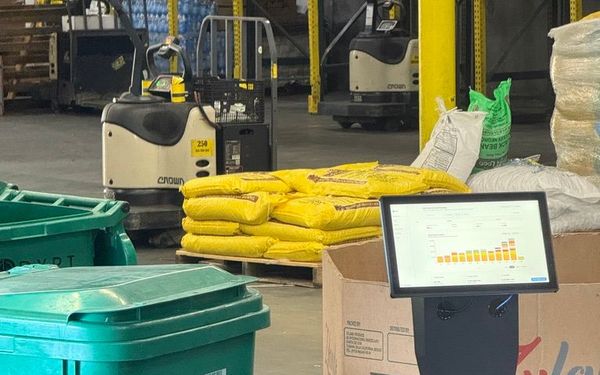
The difference is what the normalized dataset then feeds. Impact Engine builds Scope 1, 2, and 3 inventories from the same documents, with Scope 3 Category 5 measured from real diversion data rather than spend estimates, EPA WARM factors, an auditable chain of custody from bin to facility, and exports for LEED, GRI, CDP, TCFD, SBTi, SB 253, and SEC. DWIT adds the input no document contains: a weighed load record from an industrial scale rated 5,000+ lbs, weatherproof, at the point where waste leaves the building, captured in three taps — load, select, confirm.
That last piece changes the character of an audit. An invoice-only audit compares documents to documents: this charge against that contract clause, this rate against that benchmark. It is genuinely effective, and it catches a great deal. What it cannot do is establish that a billed event did not occur, because the only record of the event belongs to the party billing you. A weighed, timestamped load record does establish that.
Positioning comparison. The Vector97 column reflects what Vector97 publishes on vector97.com; the Dyrt column reflects shipped capability.
| Dimension | Vector97 | Dyrt |
|---|---|---|
| Core model | Managed invoice processing, audit, bill pay and negotiation with a client portal | Software platform you run, with a fully managed tier available |
| Invoice audit | Line-by-line vendor invoice audit performed by Vector97 | Continuous automated audit; findings typed as dispute, renegotiate, right-size, audit |
| Bill payment | Bill pay is part of the published service | Not a Dyrt service; Dyrt produces the evidence, your AP process pays |
| Physical measurement | Not part of the published offering | DWIT kiosk: 5,000+ lb scale, per-site stream taxonomy, offline-capable |
| Emissions and disclosure | Reporting and zero waste consulting | Scope 1, 2, 3 with Category 5 from measured diversion; LEED, GRI, CDP, TCFD, SBTi, SB 253, SEC exports |
| Typical portfolio | Property management, multifamily and retail portfolios; utility spend included | Multi-site hospitality, venues, retail and grocery, distribution |
Why does normalization matter more than the audit itself?
Every waste-spend vendor will tell you it normalizes data. The word covers a lot of unglamorous engineering, and the parts that get skipped are the parts that break analysis later.
Billing periods are the first. Haulers close their months on different days, so a naive monthly roll-up silently mixes 28-day and 35-day windows and every trend line becomes noise. Units are the second: without a common basis per stream, there is no cost-per-unit to compare. Deduplication is the third, and it matters more once you have multiple ingest paths, because the same invoice arriving by API and by email inbox double-counts both spend and emissions.
The one that decides whether the whole exercise works is site mapping. A hauler's account number for a property is not your property ID, and the two drift as sites are acquired, renamed, or re-regioned. Until they are reliably joined, you cannot answer the only question a portfolio operator really has: is this site expensive relative to its peers, or does it just look that way?
Contracts are the other half of the dataset, and they are frequently treated as background paperwork. Invoice analysis alone can tell you a charge is unusual; it cannot tell you whether it is permitted. That answer lives in the service agreement, and the terms that matter are rarely the headline rate — they are the escalation clause and its cap, the surcharge mechanics and the base they apply to, the definition of a billable event, the contamination policy and who adjudicates a claim, and the auto-renewal window with its notice requirement. Dyrt reads contracts alongside the bills for exactly that reason. Knowing which agreements come up for renewal in the next two quarters changes what is negotiable, and a notice window that closed eleven days ago is a fact that is trivially actionable in advance and entirely academic afterward.
That a charge contradicts a contract clause, exceeds a published tariff, escalated beyond the agreed cap, or is out of line with comparable sites. All of that is actionable on documents alone.
That a pull did not happen, that a load was not overweight, or that a contamination event did not occur. Those require an independent record created on your side of the fence.
A weighed, timestamped load with an optional photo and note, attributed to a stream and a site. It converts an interpretation of a contract into a discrepancy between two numbers.
Diversion rates you can defend under assurance, Scope 3 Category 5 from real weights, and a composition signal that points back at purchasing and spoilage.
What should you ask when comparing the two?
- Who performs the audit — a team, a system, or both — and what happens in the month your assigned analyst is out?
- How many of your invoices arrive as scans or photographs, and what is the process for those? Ask for the ingest path per vendor, not an average.
- Does the audit run every billing cycle or on a periodic review? Errors caught at one month old are far more likely to be credited than errors caught at eleven.
- Is bill payment included, and if so, who is liable for a payment made on an invoice later found to be wrong?
- What does the normalized dataset look like, and can you export it? Ask specifically whether the site-hierarchy mapping travels with it.
- If you need a defensible diversion number or a Scope 3 Category 5 figure next year, what is the input — spend, vendor report, or measured weight?
A continuous audit and a periodic audit are different products
An annual invoice review recovers what it can from twelve months of accumulated drift and then lets the drift restart. Running the audit every cycle catches errors while they are one month old, which is also the point at which haulers are most willing to credit them without a fight.
When is Vector97 the better fit?
There are portfolios where Vector97 is clearly the right purchase, and pretending otherwise would make the rest of this post untrustworthy.
When you want the invoices out of your building entirely. Vector97 receives, audits, and pays the bills. Dyrt does not do bill payment. If your real constraint is accounts-payable capacity across a large number of small properties, an outsourced processing and payment service solves a problem Dyrt does not touch.
When your portfolio is property management or multifamily. Vector97's published customer base and its utility-spend footprint point squarely at managed residential and mixed-use property portfolios. Dyrt is built for multi-site hospitality, venues, retail and grocery chains, and distribution, where there is a loading dock, an operating team, and material volume worth weighing.
When utilities matter as much as waste. Vector97 describes utility spend as part of what it manages. Dyrt's scope is waste and the diversion and emissions accounting that comes from it. If you want one vendor across utility and waste invoices, that is a real argument for Vector97.
When measurement is not achievable at your sites. If your locations are leased spaces with shared compactors and no dock you control, a kiosk cannot be installed and the document-based audit is the entire available opportunity. Buy the thing that works at your sites.
How should a finance lead decide?
The clean version of the decision: if the recovered dollars are the deliverable, a specialist audit-and-pay service is a direct route to them. If the recovered dollars are supposed to be the first of several outputs from one clean dataset — spend, diversion, emissions, purchasing signal — then the dataset is the product and the audit is a by-product.
That is the argument for building the pipeline properly rather than buying the recovery. Everything a company wants to say about its waste is downstream of the same documents nobody has read line by line, plus the one measurement no document contains. Dyrt's tiers are structured to let you start narrow: Track to measure, Capture to see every dollar of spend, Optimize for fully managed vendor handling through Portfolio Intelligence, priced per location.
For the direct feature comparison, see Dyrt vs Vector97: waste invoice auditing compared.
Dyrt Team
Dyrt Editorial
The Dyrt team builds waste intelligence software for sustainability managers, CFOs, and facility operators. We help organizations reduce waste costs, hit diversion targets, and simplify Scope 3 reporting.
Ready to Transform Your Waste Operations?
Dyrt helps sustainability teams, facility operators, and CFOs cut waste costs, hit diversion targets, and simplify Scope 3 reporting — all in one platform.
Request a Demo