Rubicon Alternative: Choosing Between a Managed Hauler Network and a Waste Software Platform
Teams almost never search for a "Rubicon alternative" because they have a list of missing features. They search for it because the shape of the relationship has stopped matching the shape of the problem. Somebody in finance wants to know why a line item moved and cannot get to the underlying number. Somebody in sustainability needs a diversion figure that will survive an assurance review. Somebody in operations wants to change a service level at forty locations without opening forty conversations.
Those are model questions, not feature questions, and they are the only kind worth evaluating on. This post lays out what Rubicon publishes about itself, what Dyrt is, and the specific tests that separate the two. If you finish it and conclude that Rubicon is the right answer for your portfolio, the post has done its job.
What does Rubicon actually do?
Rubicon describes itself as "a waste sciences and recycling solutions partner that helps businesses of all sizes simplify, optimize, and improve their environmental operations," and it operates through what its own site calls "an extensive network of more than 8,000 vendor and hauler partners." Rubicon does not own the trucks. It coordinates a partner network on your behalf and gives you a platform on top of it.
On its enterprise page, Rubicon positions RUBICONConnect as a way to consolidate waste services with a single partner, get visibility into service locations, and request new services through a digital platform. Its sustainability reporting aggregates waste diversion activities and generates reports covering Scope 3 emissions, carbon footprint, and cost savings. The same page describes three commercial levels — platform only; platform and people; platform, people, and procurement — scaled by number of locations. Alongside that sit Technical Advisory Services for zero-waste and circular-economy work, RUBICONRegWatch for regulatory tracking, and mail-back recycling.
That is a coherent and well-built offer. The important thing to notice is what it is: a managed vendor network with software attached. The primary value is that Rubicon stands between you and the haulers.
What is Dyrt, and how is it a different kind of thing?
Dyrt is a software platform your team runs against your own waste operation. There are three components. Spend Intelligence reads every line of your hauler invoices and contracts — ingested through vendor APIs, EDI, email parsers, and PDF OCR — then normalizes them: reconciling billing periods across haulers, converting units, deduplicating submissions that arrived twice, and mapping each vendor's facility IDs onto your actual site hierarchy. Impact Engine builds Scope 1, 2, and 3 inventories from those same bills, receipts, spreadsheets, and facility records, and exports to LEED, GRI, CDP, TCFD, SBTi, SB 253, and SEC formats. Portfolio Intelligence is the fully managed tier, where Dyrt takes over national vendor management, continuous invoice audit, dispute resolution, and switch execution.
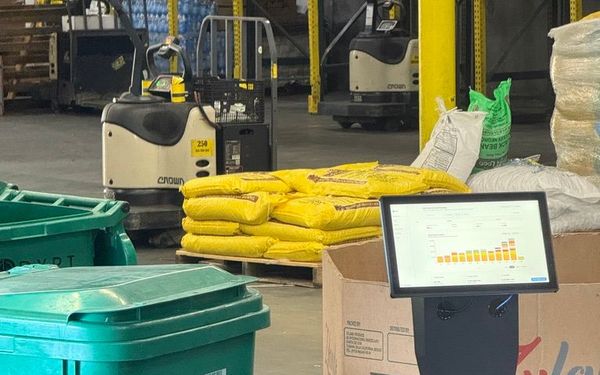
The piece with no equivalent in a network model is the hardware. DWIT — the Dyrt Waste Intelligence and Integrated Kiosk System — is an industrial scale rated for 5,000+ lbs, weatherproof, installed at the point where waste actually leaves the building. An operator does three taps: load, select, confirm. The waste-stream taxonomy is configurable per site, load photos and notes are optional, and the unit is offline-capable — it queues and syncs when the connection returns. Dyrt manages it over a private VPN with rolling updates, and every install ships with a spare-parts kit.
That distinction cascades into everything downstream. A platform fed by hauler invoices knows what you were billed. A platform fed by a scale on your dock knows what you threw away. Those are different datasets, and only one of them can contradict a hauler.
Rubicon consolidates services through its partner network so you deal with one partner. Dyrt Track and Capture leave your hauler contracts in your name; Optimize hands vendor management to Dyrt if you want that.
Invoice-derived data tells you what a vendor said happened. DWIT weighs each load at the source, so the tonnage in your reports is a measurement rather than an inference.
Ask both vendors what happens to your normalized history, your site hierarchy mapping, and your emissions factors on the day the contract ends.
How do Dyrt and Rubicon compare side by side?
Positioning comparison. Rubicon column reflects what Rubicon publishes on rubicon.com; the Dyrt column reflects shipped capability.
| Dimension | Rubicon | Dyrt |
|---|---|---|
| Core model | Managed partner network plus platform | Software platform you operate, with an optional managed tier |
| Hauler network | More than 8,000 vendor and hauler partners | No hauler network; works against the vendors you already use |
| Primary data source | Service records and consolidated invoicing | Invoices and contracts, plus weighed loads where DWIT is installed |
| On-site hardware | Not part of the published platform | DWIT kiosk: 5,000+ lb industrial scale, weatherproof, offline-capable |
| Emissions reporting | Scope 3, carbon footprint, and cost reporting from aggregated diversion activity | Scope 1, 2, 3 with Category 5 from measured diversion; EPA WARM; LEED, GRI, CDP, TCFD, SBTi, SB 253, SEC |
| Commercial structure | Three levels — platform; platform and people; platform, people and procurement — scaled by locations | Track, Capture, Optimize — priced per location; kiosks are one-time hardware plus monthly per location |
Why does the data source change what you can do with the platform?
Consider a contamination fee. In an invoice-derived system, a contamination charge is a fact about your bill. You can see it, categorize it, chart it over time, and note that it went up. What you cannot do is contest it, because the only record of the event is the one the party charging you created.
Now add a weighed, timestamped load record at the dock. The same fee becomes a claim you can check against your own measurement of what left the building and when. Dyrt sorts findings into four types for exactly this reason: dispute, renegotiate, right-size, and audit. Each demands a different response, and only some of them are winnable on invoice data alone.
Which ones need measurement, and which do not
Billed for something with no service record
A pull, pickup, or event that has no corresponding record on your side — and, where a kiosk is installed, no corresponding weight.
Recommendation: Strongest with measurement. A weighed load record turns an argument into a discrepancy.
Effective rate is out of line with the portfolio
The all-in per-unit rate at this site is materially above comparable sites in the same market.
Recommendation: Works on normalized invoice data alone. Requires the site-ID mapping to be correct.
Service level exceeds actual demand
Container size or pickup frequency was set for a demand profile the site no longer has.
Recommendation: Measurement makes this decisive. Consistently light hauls are only visible if hauls are weighed.
Charge does not trace to any document
A fee with no contract clause, service record, or published tariff behind it. Not necessarily wrong, but not yet justified.
Recommendation: Request substantiation before the next cycle so it does not quietly become precedent.
What should you actually ask on the evaluation call?
Both vendors will demo well. These are the questions where the answers diverge, and where a diverging answer tells you something real about which model you are buying.
- Where does the tonnage in this dashboard come from? Ask them to trace one number back to its source document or measurement, on a real site, live.
- If a hauler bills a fee we do not believe happened, what evidence does your product put in my hands? Ask for a redacted example of a filed dispute.
- Who signs the hauler contract after we sign with you, and whose name is on it at renewal?
- When we ask for our data on the last day of the contract, what format arrives, and does it include the normalized history or only the raw files?
- For Scope 3 Category 5, is the number derived from spend, from vendor-reported diversion, or from measured weight? Ask which factors are applied and whether the chain of custody is auditable from bin to facility.
- What does a service-level change at forty locations look like operationally — who executes it, and how is completion verified?
The single most useful question
Ask any waste vendor to show you the difference between what a hauler reported and what was actually measured at one of your sites. A platform that cannot answer that question is not wrong or badly built — it simply is not built to answer it, and you should know that before you buy it rather than during your first audit.
When is Rubicon the better fit?
There are portfolios where Rubicon is the more sensible purchase, and being honest about them is the only way the rest of this post is worth reading.
If your actual problem is vendor sprawl, not measurement. A company with hundreds of small sites, dozens of local haulers, and no internal waste function often needs consolidation before it needs precision. Rubicon's network and single-partner consolidation are aimed directly at that, and a measurement platform will not solve it.
If you need service coverage in places you cannot source yourself. A partner network of the scale Rubicon publishes is a genuine asset when you are opening locations in markets where you have no hauler relationships. Dyrt does not operate a hauler network and will not pretend that is a small difference.
If you have no appetite for hardware. DWIT is an installed industrial kiosk. It requires a location, a workflow change for dock staff, and an owner. If nobody in your organization will own that, you will not get the measurement benefit, and you should buy the model that does not depend on it.
If you want one throat to choke and are content with vendor-reported numbers. That is a legitimate position, particularly where waste is a small share of controllable spend and no regulator is asking for assured diversion figures yet.
How should a multi-site operator decide?
The decision usually comes down to which failure mode you can least afford. If your worst outcome is fragmented service and unmanageable vendor count, buy consolidation. If your worst outcome is reporting a diversion number you cannot defend, or paying an invoice you cannot contest, buy measurement.
Dyrt is built for the second failure mode, which is why its natural buyers are multi-site hospitality groups, venues, retail and grocery chains, and distribution operators — organizations where a CFO, a facilities director, and a sustainability lead all need the same number to mean the same thing. The three tiers exist to let those organizations start where the pain is: Track to measure, Capture to see every dollar of spend, Optimize to hand the whole function over.
There is also a research argument, which matters more than it sounds. Dyrt runs Labs in Vernon, California, a facility processing roughly 1,000,000 lb per month, where Dyrty Vision applies computer vision to organics sort lines and composition models are in pilot with two hospitality groups. That work exists because measurement is the product, and it has to keep getting better.
If you want the feature-level walk-through rather than the model-level one, we published a direct comparison: Dyrt vs Rubicon: waste management platforms compared.
Dyrt Team
Dyrt Editorial
The Dyrt team builds waste intelligence software for sustainability managers, CFOs, and facility operators. We help organizations reduce waste costs, hit diversion targets, and simplify Scope 3 reporting.
Ready to Transform Your Waste Operations?
Dyrt helps sustainability teams, facility operators, and CFOs cut waste costs, hit diversion targets, and simplify Scope 3 reporting — all in one platform.
Request a Demo