RoadRunner Alternative: Volume Sensing, Weight Measurement, and Which One Your Reports Need
RoadRunner and Dyrt get compared often, and for a good reason: both argue that the waste line item is mispriced because nobody has real data about it. They disagree about what "real data" means. RoadRunner measures how full a container looks. Dyrt measures how much a load weighs. Almost every other difference between the two companies follows from that one choice.
If you are searching for a RoadRunner alternative, the useful exercise is not comparing dashboards. It is deciding which measurement your finance, operations, and sustainability teams need to be able to defend — and whether you want a partner to run the waste function or a platform to run it yourself.
What does RoadRunner actually do?
RoadRunner describes its offer as "tech-enhanced, fully-managed waste services and recycling services" intended to streamline operations, drive cost savings, and increase landfill diversion. Its site is explicit that it is "not a traditional hauler" — it does not own trucks, dumpsters, or landfills — which lets it optimize service rather than sell tipping fees. Alongside the managed service it publishes RecycleMORE, CleanStream Recycling, ESG Reporting, and TRUE Zero Waste Advisors.
The interesting part is the named technology stack, because RoadRunner is unusually specific about it:
- Waste Metering — described on RoadRunner's technology pages as rugged in-dumpster smart cameras powered by AI, with wide-angle flash-enabled lenses, GPS, tilt sensors to detect service events, grime-resistant coating, and cell-network connectivity. It monitors fullness, contents, contamination, and service activity.
- OverSite — a centralized platform that, in RoadRunner's words, "houses all customer and operational data, allowing our teams to take action on your waste so you don't have to," including service information, contract details, and vendor performance reporting.
- BillCheck — invoice verification that flags billing discrepancies for RoadRunner's team to resolve.
- PriceShield — AI over pricing, service, and vendor data across RoadRunner's customer base, used to secure competitive rates and limit rate increases.
That is a serious product. It is also, by its own description, a managed service in which RoadRunner's teams act on your waste so you do not have to. Whether that sentence reads as a benefit or a constraint is most of your decision.
What is the difference between metering by volume and measuring by weight?
A camera inside a container answers a genuinely valuable question: is this thing full enough to justify the pull we are about to pay for? That is the right question for right-sizing service frequency, and visual monitoring answers it without any change to how dock staff work.
It does not answer the questions that live downstream of tonnage. Waste is billed by weight at the scale house, carbon is calculated per ton of material by stream, diversion rates are ratios of weights, and a disputed overweight charge is settled in pounds. Volume is a proxy for all of those, and the conversion factor between volume and weight is not stable — it moves with material mix, moisture, compaction, and season. A container of baled cardboard and a container of wet organics can look identically full and differ by a factor of several in mass.
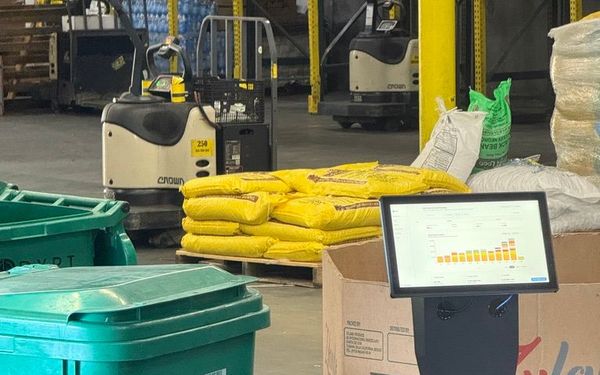
DWIT, the Dyrt Waste Intelligence and Integrated Kiosk System, takes the other approach. It is an industrial scale rated 5,000+ lbs, weatherproof, installed where waste leaves the building. The operator does three taps — load, select, confirm — against a waste-stream taxonomy configured for that specific site, with an optional load photo and notes. It syncs to the portal in real time and is offline-capable, queuing records and syncing on reconnect. Dyrt manages the fleet over a private VPN with rolling updates, and every install includes a spare-parts kit.
The cost is honest: DWIT requires a workflow change. Someone has to weigh the load. That is three taps, not a form, but it is not zero. In exchange you get a weighed, timestamped, attributed record of every load — the unit that invoices, contracts, and carbon accounting are all actually denominated in.
Positioning comparison. The RoadRunner column reflects what RoadRunner publishes on roadrunnerwm.com; the Dyrt column reflects shipped capability.
| Dimension | RoadRunner | Dyrt |
|---|---|---|
| Model | Fully-managed waste and recycling service, non-asset-based | Software platform you run; Optimize tier is fully managed if you want that |
| Site-level sensing | Waste Metering — in-dumpster AI cameras: fullness, contents, contamination, service events | DWIT kiosk — 5,000+ lb industrial scale: weighed load, stream, timestamp, optional photo |
| Unit of measure | Container volume and service activity | Weight per load per stream |
| Invoice handling | BillCheck flags discrepancies; RoadRunner’s team resolves them | Spend Intelligence ingests via API, EDI, email parsers and OCR, normalizes, and produces evidence you can file yourself |
| Rate leverage | PriceShield benchmarks against RoadRunner’s customer base | Benchmarks against your own normalized portfolio; Optimize executes switches |
| Who acts on findings | RoadRunner’s teams, by design | Your team on Track and Capture; Dyrt on Optimize |
Why do teams look for a RoadRunner alternative?
In our experience the reasons cluster into three, and none of them are complaints about product quality.
The first is auditability. A sustainability lead preparing for external assurance, a LEED submission, or SB 253 disclosure needs to explain where a tonnage figure came from. An answer of the form our vendor assessed container fullness and applied conversion factors is a defensible methodology, but it is an estimate, and reviewers treat estimates differently from measurements. Impact Engine exists to close that gap: Scope 1, 2, and 3 built from bills, receipts, spreadsheets, and facility records, with Scope 3 Category 5 measured from real diversion data rather than spend estimates, EPA WARM factors, an auditable chain of custody from bin to facility, and exports for LEED, GRI, CDP, TCFD, SBTi, SB 253, and SEC.
The second is control of the vendor relationship. A fully managed model is a relief when you have no internal waste function and a liability when you do. If your procurement team wants to run the hauler RFP themselves with data in hand, a model built around the vendor taking action on your behalf is working against you rather than for you.
That control question shows up most concretely in what happens to a finding. Detecting a problem and resolving it are separate activities, and the two models split them differently.
The four finding types Dyrt Spend Intelligence produces
Charged for a service with no record
A pull or event with nothing corresponding on your side, and no weight where a kiosk is installed.
Recommendation: Dyrt assembles the evidence for you to file, or files it for you in the Optimize tier.
All-in rate above comparable sites
Effective per-unit rate materially out of line with peer sites in the same market.
Recommendation: Benchmarked against your own portfolio rather than a vendor’s customer base, so you can show your work.
Service exceeds actual demand
Frequency or container size set for a demand profile the site no longer has.
Recommendation: Confirmed against weighed hauls, then verified again after the change takes effect.
Fee with no document behind it
No contract clause, service record, or published tariff supports the charge.
Recommendation: Request substantiation before the next cycle rather than after twelve of them.
The third reason is that measurement turns out to be useful beyond waste. Once you know the weight and composition of what each site discards, you are holding a purchasing dataset: over-ordering, spoilage, packaging decisions, and portion sizing all show up in the bin before they show up anywhere else.
Your dominant problem is paying for pulls of half-empty containers, and you cannot add a step to dock workflow at any site.
You need tonnage that survives assurance, you dispute hauler charges, or you report Scope 3 Category 5 to a framework.
Nobody internally owns waste, and you would rather buy an outcome than build a capability.
What should you ask both vendors?
- Show me one tonnage figure and trace it to its source. Is it a measurement, a vendor report, or a modeled conversion from volume?
- When a hauler charges an overweight or contamination fee we dispute, what artifact does your product hand me to contest it?
- For Scope 3 Category 5, what is the input — spend, vendor-reported diversion, or measured weight? Which factor set is applied?
- Who negotiates the hauler contract, and whose name is on it? What happens at renewal if we leave you?
- What exactly is installed at the site, who maintains it, who pays for a damaged unit, and how long does a replacement take?
- On the last day of the contract, what do we receive — raw files, or the normalized history with the site-hierarchy mapping intact?
Hardware questions are not a detail
Any sensing hardware in a waste environment gets hit, buried, rained on, and occasionally driven into. Ask both vendors who owns the failure: who is notified, who ships the part, who pays, and what the data record looks like for the days a unit was down. Dyrt manages DWIT over a private VPN with rolling updates and ships a spare-parts kit with every install, specifically so this conversation happens before the install rather than after the first outage.
When is RoadRunner the better fit?
Several situations genuinely favor RoadRunner, and a reader in one of them should stop comparing and go buy it.
When the problem is over-service, full stop. If your waste spend is high because containers are pulled half-empty on schedules nobody has revisited, camera-based fullness monitoring plus a team that adjusts the schedules addresses that directly, with no workflow change at the site.
When you have no internal owner. A fully managed, non-asset-based partner is the right structure when waste cannot be anyone's job internally. Dyrt has a managed tier in Portfolio Intelligence, but it is built for hospitality, venue, and retail portfolios of 50-plus locations. Below that threshold, a managed specialist may simply be a better commercial fit.
When installing a kiosk is not realistic. Compactor-only sites, leased docks you do not control, and locations where staff turnover makes any new workflow fragile are all cases where measurement hardware will underperform its promise. A camera in a container is a much lower-friction intervention, and that is a real advantage.
When your reporting bar is internal, not external. If nobody is auditing your diversion rate and no disclosure regime applies to you yet, the precision difference may not be worth paying for this year.
How do you make the call?
Write down the last three waste decisions your organization got wrong and ask which dataset would have prevented each. If the answers are about pulling containers too often, buy volume sensing and a managed team. If the answers are about charges you could not contest, diversion numbers you could not defend, or spend you could not attribute to a site, buy measurement.
Dyrt is priced to make that a staged decision rather than a leap: Track to measure, Capture to see every dollar of spend, Optimize for fully managed, priced per location, with kiosks as one-time hardware plus a monthly subscription per location and no per-seat or per-feature gates. Most portfolios start with a handful of sites, prove the delta between billed and measured, and expand from there.
For the feature-by-feature version of this analysis, see Dyrt vs RoadRunner: which waste platform cuts costs faster.
Dyrt Team
Dyrt Editorial
The Dyrt team builds waste intelligence software for sustainability managers, CFOs, and facility operators. We help organizations reduce waste costs, hit diversion targets, and simplify Scope 3 reporting.
Ready to Transform Your Waste Operations?
Dyrt helps sustainability teams, facility operators, and CFOs cut waste costs, hit diversion targets, and simplify Scope 3 reporting — all in one platform.
Request a Demo