ENGIE Impact Alternative: Multi-Resource Breadth or Waste-Specific Depth?
ENGIE Impact and Dyrt are not really competing for the same budget line, and the most useful thing this post can do is explain why — because a lot of enterprises evaluate them side by side and then choose on the wrong criteria.
ENGIE Impact is a multi-resource sustainability practice: energy, water, waste, telecom, and carbon, with consulting attached. Dyrt is a waste platform that goes deep on one resource, including hardware at the point of disposal. If waste is one of five resource programs you are trying to get under control, those are different purchases. If waste is the program that keeps producing numbers nobody can defend, they are alternatives, and the comparison is worth making carefully.
What does ENGIE Impact actually do?
ENGIE Impact positions itself around sustainable resource management for multi-site organizations, turning resource data into actionable intelligence across energy, water, waste, telecom, and carbon. Its published capabilities include resource management, expense and data management, and sustainability consulting covering decarbonization, clean technology, e-mobility, and renewable energy.
On the waste side specifically, ENGIE Impact publishes several distinct capabilities: total waste management for multi-site businesses, waste procurement in which it contracts haulers as an independent third party working for the client rather than the haulers, waste expense management which tracks waste service invoice data and conducts pre- and post-payment audits for service-level and billing accuracy, waste audits, and waste compliance services. Underneath sits its Data Management Platform, which unifies energy, water, and waste data across a global portfolio of sites into one view.
That is an unusually broad footprint, and the breadth is the point. ENGIE Impact is built for organizations whose sustainability problem spans every utility and every geography, and which want advisory capacity alongside data.
What is Dyrt, and where is it deliberately narrower?
Dyrt does waste, and only waste, at a level of resolution that a multi-resource platform is not designed for.
Spend Intelligence reads every line of hauler invoices and contracts, ingested monthly through vendor APIs, EDI, email parsers, and PDF OCR, then normalized — billing periods reconciled across haulers that close their months on different days, units converted, duplicate submissions removed, vendor facility IDs mapped onto your site hierarchy. Findings are typed as dispute, renegotiate, right-size, or audit, because each requires a different response.
Impact Engine builds Scope 1, 2, and 3 inventories from bills, receipts, spreadsheets, and facility records, with Scope 3 Category 5 measured from real diversion data rather than spend estimates. It applies EPA WARM, maintains an auditable chain of custody from bin to facility, and exports to LEED, GRI, CDP, TCFD, SBTi, SB 253, and SEC, in CSV, JSON, or via API.
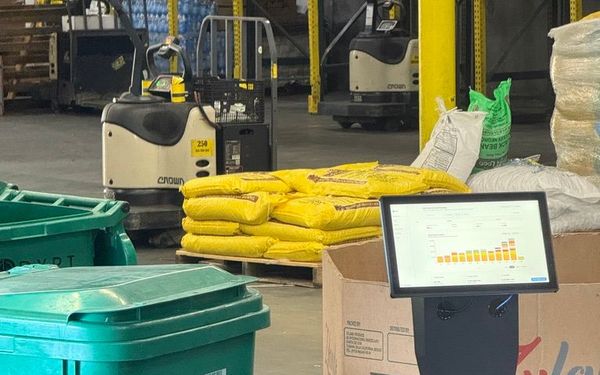
DWIT — the Dyrt Waste Intelligence and Integrated Kiosk System — is the part with no analogue in a resource-management practice. It is an industrial scale rated 5,000+ lbs, weatherproof, at the point where waste leaves the building. Three taps: load, select, confirm. Per-site configurable stream taxonomy, optional load photo and notes, real-time portal sync, offline-capable with queued sync on reconnect, managed by Dyrt over a private VPN with rolling updates, spare-parts kit in every install.
And Portfolio Intelligence is the managed tier: national vendor management across hauler and utility contracts, continuous invoice audit and dispute resolution, right-sizing and switch execution, ground-truth verification from loading docks and food-and-beverage teams, monthly reporting, and quarterly business reviews — built for hospitality, venue, and retail portfolios of 50-plus locations.
Positioning comparison. The ENGIE Impact column reflects capabilities published on engieimpact.com; the Dyrt column reflects shipped capability.
| Dimension | ENGIE Impact | Dyrt |
|---|---|---|
| Resource scope | Energy, water, waste, telecom, carbon | Waste, and the diversion and emissions accounting that follows from it |
| Core model | Resource management practice: data platform plus expense management plus consulting | Software platform with on-site hardware, plus an optional managed tier |
| Waste data source | Invoice and service data across sites, plus waste audits | Invoices and contracts, plus independently weighed loads where DWIT is installed |
| Invoice work | Pre- and post-payment audits for service-level and billing accuracy | Continuous audit every cycle, typed findings, dispute execution in the Optimize tier |
| Procurement | Hauler contracting as an independent third party for the client | National vendor management and switch execution in the Optimize tier |
| Geography | Global portfolios | North American multi-site portfolios |
| Advisory | Sustainability consulting including decarbonization, clean tech, e-mobility, renewables | Not a consultancy; research through Dyrt Labs feeds the product |
Why does resolution matter more than breadth for waste specifically?
Energy and water have a structural advantage that waste does not: they are metered by the utility. A kilowatt-hour is a kilowatt-hour, the meter is calibrated, and the bill is arithmetic on a reading both parties can inspect. Disputes are about rate structure, not about whether the consumption happened.
Waste has no meter. What exists instead is a scale at a facility you do not operate, a truck driver's service record, and a container size someone wrote down when the contract was signed. Every downstream number — cost per ton, diversion rate, Scope 3 Category 5 — inherits whatever that chain produced. This is why a platform that treats waste as one more utility feed can produce a beautifully consistent portfolio view built on inputs nobody has independently verified.
Installing a meter is the whole idea behind DWIT. Once the weight is captured on your side of the fence, three things become possible that were not before: you can contest a charge with a measurement rather than an interpretation, you can report a diversion rate with a chain of custody that starts at the bin, and you can see composition — which is a purchasing signal, not a waste signal.
Illustrative of the mechanism, not of recovery amounts
Charge for a service with no record on your side
Invoice-only analysis can show the charge is unusual. A weighed, timestamped load record shows what actually left the building that day.
Recommendation: File with measurement attached rather than with an argument attached.
Effective all-in rate out of line with peers
Requires correct site mapping and unit normalization across haulers before any comparison is meaningful.
Recommendation: Take the benchmark into renewal with the comparable sites named.
Service level exceeds real demand
Consistently light hauls are the tell, and light hauls are only visible if hauls are weighed rather than counted.
Recommendation: Reduce frequency or downsize, then verify against measured volume.
Fee that traces to no document at all
No contract clause, no service record, no published tariff. Not necessarily improper, but unsubstantiated.
Recommendation: Request substantiation before it becomes an accepted line item.
What should you ask on the evaluation call?
- For waste specifically, what is the source of the tonnage figure — hauler report, spend-based estimate, or independent measurement?
- For Scope 3 Category 5, which methodology and factor set is applied, and can the chain of custody be traced from the bin to the receiving facility?
- How often does the invoice audit run — every billing cycle, quarterly, or annually? Errors caught at one month old are far more likely to be credited.
- Who takes a finding to the hauler, and who signs the resulting contract change?
- Which framework exports are native, and in what formats do we receive the underlying dataset?
- If we later want to instrument sites directly, does the platform accept weighed load data as a first-class input, or as a manual override?
Breadth and depth are both real strategies
An enterprise with a global energy transition program and a waste line item that is merely untidy should almost certainly buy breadth. An enterprise whose diversion figures are about to be externally assured, or whose hauler spend is materially wrong at the site level, needs depth on that one resource. The mistake is buying breadth and then expecting depth from it.
Energy, water, telecom and carbon all need to land in one portfolio view, the geography is global, and the resources in question are already metered by utilities.
A diversion figure is heading for external assurance, hauler spend is materially wrong at site level, or you intend to contest charges rather than categorize them.
The work is strategy — decarbonization pathways, clean technology selection, renewable procurement. That is a consulting engagement, not a product purchase.
The missing input is the reading itself. Waste is the one resource on the list with no utility meter, and no amount of platform breadth substitutes for a scale.
When is ENGIE Impact the better fit?
For a large share of the enterprises reading this, ENGIE Impact is the correct answer, and here is how to recognize whether you are one of them.
When waste is one line in a multi-resource program. If energy, water, telecom, and carbon all need to land in one view alongside waste, a platform designed for exactly that is worth more than a specialist tool that covers one of the five. Dyrt does not manage energy or water consumption programs.
When your portfolio is global. ENGIE Impact publishes global portfolio coverage. Dyrt is built for North American multi-site operations. If your sites span continents, that is a decisive practical difference and not one a feature list will fix.
When you need strategic advisory, not just data. Decarbonization strategy, clean technology evaluation, e-mobility, and renewable procurement are consulting engagements. Dyrt is a product company with a research facility, not a consultancy, and it will not staff a transition strategy for you.
When utility expense management is the actual mandate. If the project is consolidating and auditing invoices across every resource type with a single vendor, ENGIE Impact's expense and data management capability is aimed directly at that scope.
When you have no site-level instrumentation appetite. DWIT is a physical install with a workflow change and an internal owner. Without that owner, the measurement advantage does not materialize, and the broader platform is the better buy.
How should an enterprise sequence this?
Many organizations end up running both kinds of vendor, and the sequencing that works is usually breadth first for the resources that are metered, depth second for the one that is not. Get energy, water, and telecom into a single view where the underlying readings are already trustworthy. Then instrument waste, because waste is the resource where the reading itself is the missing piece.
Dyrt's tiers are built to slot into that sequence without a large commitment: Track to measure, Capture to see every dollar of spend, Optimize to hand the function over. Pricing is per location, kiosks are one-time hardware plus a monthly subscription per location, and nothing is gated per seat or per feature. Most portfolios start with a small number of sites, quantify the gap between billed and measured, and expand from there.
The research behind that measurement runs at Dyrt Labs in Vernon, California — roughly 1,000,000 lb per month of throughput, where Dyrty Vision applies computer vision over organics sort lines, composition models are in pilot with two hospitality groups, and lifecycle attribution connects material back to its origin.
For the direct comparison, see Dyrt vs ENGIE Impact: enterprise waste management compared.
Dyrt Team
Dyrt Editorial
The Dyrt team builds waste intelligence software for sustainability managers, CFOs, and facility operators. We help organizations reduce waste costs, hit diversion targets, and simplify Scope 3 reporting.
Ready to Transform Your Waste Operations?
Dyrt helps sustainability teams, facility operators, and CFOs cut waste costs, hit diversion targets, and simplify Scope 3 reporting — all in one platform.
Request a Demo